
Lift station monitoring has a timing problem. The equipment you most need to watch is usually the equipment nobody is standing next to. Many pumps run unattended for days or weeks, and the first sign of trouble is often an alarm after the pump has already stopped keeping up.
Back in 2022, one of our water utility deployments showed how much that can change. Within the same week we installed a single sensor on a raw water lift pump, it caught a problem live, during a customer meeting, and the crew fixed it before the pump failed. I want to walk through what happened, because the lessons apply to any utility running pumps in places that are hard to watch.
What Is Lift Station Monitoring, and Why Is It Hard?
A lift station moves water or wastewater uphill when gravity can’t do the job. As the Environmental Finance Center Network explains in its guide to lift station operation and maintenance, lift stations are installed at low points in the collection system where continued gravity flow is not possible or practical.
That placement is exactly what makes lift station monitoring difficult. These sites are spread across a service area, they are usually unattended, and many have no convenient power, wiring, or network connection for adding new instruments.
Most stations rely on level controls. Float switches turn pumps on and off as the wet well fills and drains, and an upper float triggers a high-level alarm. That alarm is valuable, but it tells you the pumps are not functioning properly or can’t keep up with the flow. In other words, it describes a problem that is already underway.
What a level alarm doesn’t tell you is how the pump itself is behaving. Is the motor running hotter than normal? Is the impeller pulling something it shouldn’t? Is vibration creeping up week over week? That is where pump condition monitoring earns its place.
What Happened at the Raw Water Lift Pump?
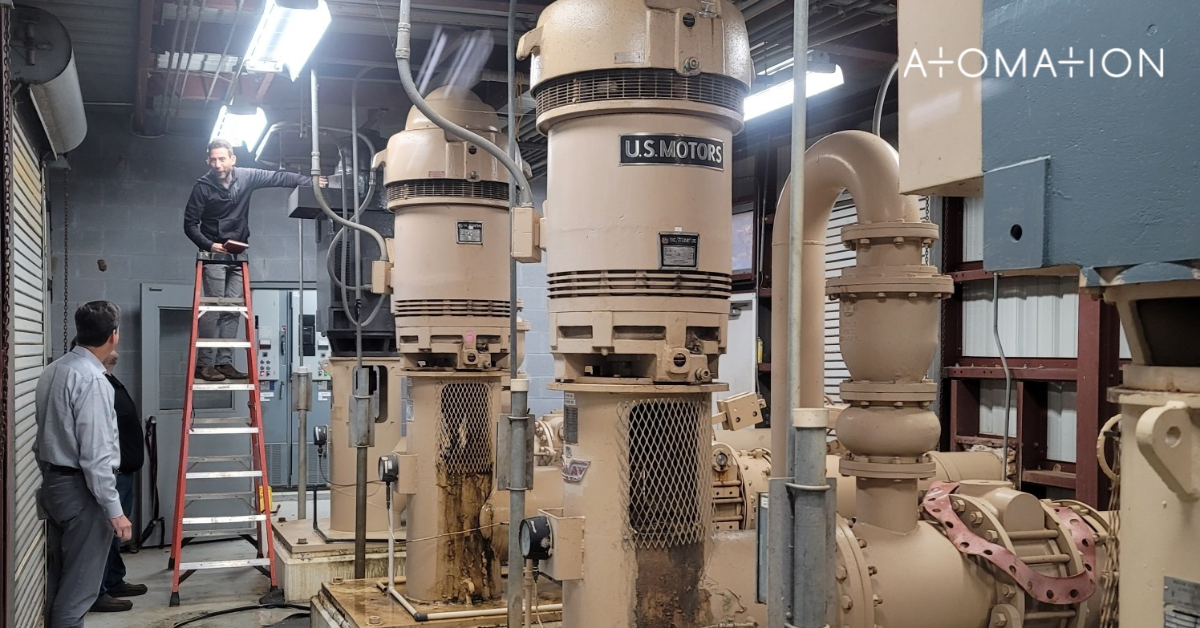
The customer was a water supply facility providing drinking water to a large metropolitan area in the South. The equipment was a raw water lift pump: a large electric motor that spins an impeller and pulls water in from the river before treatment.
The setup was as simple as it gets:
- One Gateway, battery powered, sending data over cellular
- One R sensor, mounted on the pump, with temperature, vibration, and impact sensing turned on
We installed both on a Monday. The goal was to show the utility team what the system could tell them about pump operation. A follow-up meeting was already on the calendar for later that week to review the data.
The first few days were uneventful. The charts we prepared showed basic vibration and performance data, nothing out of the ordinary. That “boring” data mattered, though. It gave everyone a baseline for how this pump normally behaves.
How Did a Brand-New Sensor Catch It So Fast?
During the follow-up meeting, our team switched from the prepared charts to a live view of the dashboard to answer a few questions. Right after logging in, with everyone still sitting at the table, the dashboard started showing trigger events. Impact and vibration readings were well above the alert threshold.
We paused the meeting. Someone from the utility went out to inspect the pump, and by their own admission, they were a little skeptical.
They found debris, later identified as a large stick, pulled into the intake valve. It was causing the pump to run erratically. The crew shut the pump down and removed the obstruction. That prevented the eventual failure of the pump and any further damage.
The data told one more story afterward. Comparing vibration before and after the incident showed the pump running with higher vibration than its original baseline. That kind of change is worth tracking over time, because it may point toward a future replacement.
What Does Pump Vibration Monitoring Show That a Level Alarm Doesn’t?
A level alarm and a vibration sensor answer different questions. One watches the water. The other watches the machine.
Pump vibration monitoring picks up mechanical changes inside the equipment: an obstruction, a bearing starting to wear, misalignment, or a loose mount. Temperature adds context. A bearing or motor running hotter than its normal range is often the next clue. Impact sensing catches sudden events, like a jolt from something moving through the intake.
In this case, impact and vibration were the signals. Both stood out sharply against a baseline that was only a few days old. Our team happened to be looking at the dashboard when it happened, but nobody has to be. Alert decisions happen at the sensor, based on the thresholds you set, so the same events notify operators wherever they are.
That is the practical value of pump condition monitoring as part of lift station monitoring. Instead of learning about a problem when the wet well rises, operators get a signal from the pump itself.
Why Does Remote Equipment Monitoring Fit Lift Stations So Well?
Lift stations are the definition of remote equipment monitoring. For lift station monitoring, the challenge isn’t whether the data is useful. It’s whether you can get it without a big project.
Here is what makes a wireless approach practical at these sites:
- No wiring or facility network. The R sends data to the Gateway over Bluetooth, and the Gateway sends it to the cloud over cellular (Cat M1/LTE-M). Nothing ties into the station’s controls or IT network.
- Battery powered. The R runs on a lithium battery rated for up to three years depending on usage, and the Gateway is battery powered too. You don’t need to find an outlet.
- Fast installation. The R mounts with screws, magnets, zip ties, or epoxy. Configuration happens in the app or dashboard.
- Alerts, not data dumps. Decisions about when to alert happen on the edge, so operators receive notifications when something crosses a threshold rather than sifting through continuous data streams.
- Open data. Alerts and readings are available through the dashboard and our open API, so they can flow into the systems a utility already uses.
You can see the full specifications on the R sensor page, and more examples of how we support water and power providers on our utilities and infrastructure page.
Temperature Matters at Pump Stations Too
Vibration got the headline in this story, but temperature alerts have caught problems at water facilities as well. In a separate deployment, a utility installed sensors to watch bearing temperature in a raw water pump house and added an alert for below-freezing conditions.
When that alert fired, maintenance found the pump house heater had run out of fuel. Frost had formed on the floor and the pipes were at risk. The team refilled and restarted the heater before anything froze. You can read the full story in Atomation Saves: Raw Water Pump Room.
For lift station monitoring, the takeaway is that the same small sensor can watch for more than one kind of problem. You set the thresholds that matter for that site.
How Do Utilities Monitor Remote Lift Station Pumps?
Most utilities use a combination of methods:
- Level controls and alarms that start and stop pumps and warn when the wet well gets too high.
- Scheduled site visits for inspection and cleaning. Guidance from the Environmental Finance Center Network recommends inspecting and cleaning floats and cables at least quarterly.
- Pressure monitoring on the force main, where changes over time can point to a clog, a break, or a leak.
- Condition monitoring on the pump itself, using vibration, temperature, and impact sensing to spot mechanical changes between visits.
The first three are the backbone of most lift station monitoring programs. The fourth is where many stations have a gap, simply because adding wired instrumentation at a remote site has historically been expensive and slow. Wireless, battery-powered lift station monitoring closes that gap without a construction project.
It also helps a utility stay ahead of the bigger consequences. The U.S. EPA lists blockages, line breaks, and power failures among the causes of sanitary sewer overflows. An early signal from a pump gives crews more time to respond on their terms.
The Broader Lesson
This save happened before the utility had even finished evaluating the system. The pump had a baseline that was only days old, and that was enough to make an unusual event stand out.
The lesson isn’t that every installation will produce a dramatic moment in a meeting room. It’s that the pump usually tells you something is wrong before the rest of the system does. Lift station monitoring is about making sure someone hears it.
We have seen the same pattern across industries. One early alert at a port led to a new inspection policy across an entire fleet, which you can read about in How One Alert Led to a Fleet-Wide Policy That Prevented Weeks of Downtime.
Ready to Add Lift Station Monitoring to Your Remote Sites?
If you have pumps in places that are hard to reach, hard to wire, or hard to watch, we can help you start small. One Gateway and a few sensors are enough to establish a baseline and start getting alerts. Contact our team to talk through your lift stations and pump stations.